
Forma · Muscle recovery tracker for iPhone
Your body chooses today's workout.
Forma estimates recovery for each muscle group from your logged workouts, then suggests a session adapted to your training history and available equipment.
Recovery
Recovery-based training, not a fixed script
Forma uses your logged workouts to estimate recovery by muscle group and suggest your next session. These estimates help organise training; they do not measure your physical condition or replace how you feel. Adjust the suggested session to your fatigue and any pain, and seek qualified advice when returning from an injury.
How recovery-based training works
Log your last session
Record which muscle groups you trained and when, giving Forma a baseline for current fatigue.
Recovery is calculated in real time
A fatigue-decay model tracks each muscle group individually: chest still sore, quads fresh, and so on.
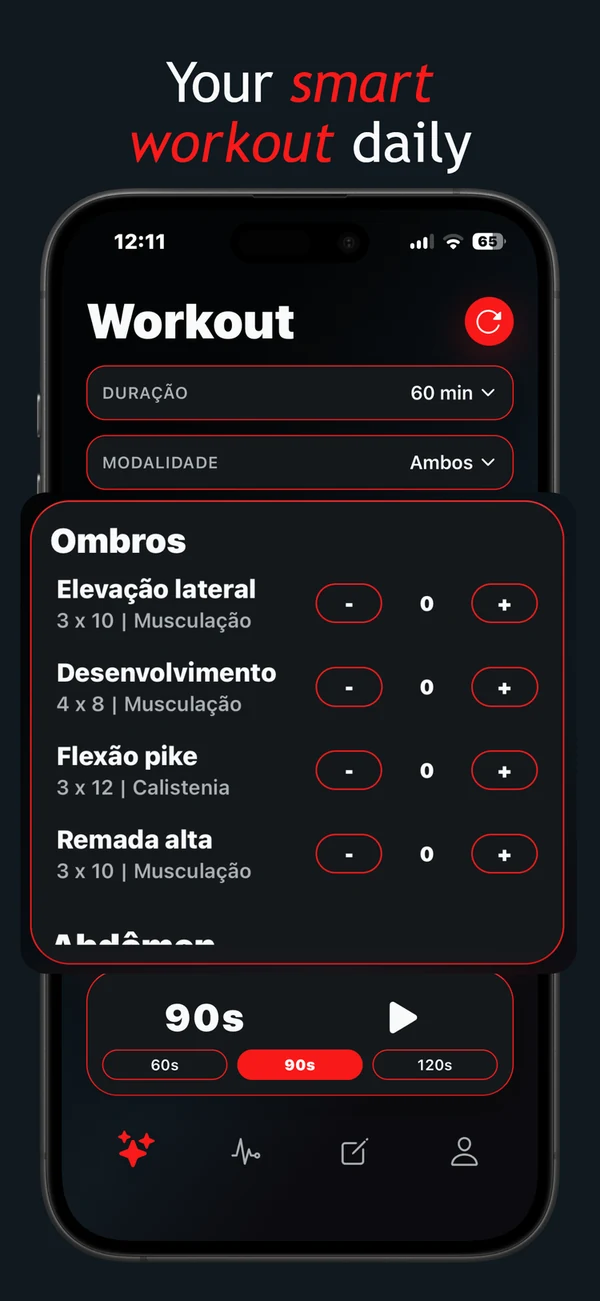
A session generated for today
Forma prioritizes recovered muscle groups and rotates away from fatigued ones automatically.
Adjust whenever you want
Switch to Custom mode to pick exercises manually; Forma adapts future suggestions accordingly.
What's inside
Smart mode
Workouts generated automatically from your training history and estimated muscle recovery.
Custom mode
Full manual control whenever you want it. Forma learns your preferences over time.
Equipment flexibility
Gym, home, or bodyweight only. Filter exercises by what you actually have available.
Exercise library
A strength-training database tagged by equipment, muscle group, and difficulty.
Progress tracking
Log sets, reps, and weight, and see progression over weeks and months.
No social layer
No feeds, no profiles, no comparison. Just the next session.
See it in action


Frequently Asked Questions
How long does muscle recovery actually take?
Recovery time varies by muscle group, training intensity, and individual factors like sleep and nutrition. As a general guideline, smaller muscle groups often recover within 24 to 48 hours, while larger muscle groups can take up to 72 hours or more after an intense session. This is a general pattern, not a fixed rule for everyone.
Should I train a muscle group that's still sore?
Training a muscle that has not fully recovered can reduce the quality of that session and may increase injury risk if the soreness is significant. Light soreness is common and not always a reason to skip training entirely, but persistent or sharp pain is a signal to rest or consult a professional.
What does Forma mean by muscle fatigue decay?
It is a model of how a muscle group's recovery level changes over time after a workout, starting low right after training and gradually returning to a fully recovered state. Forma uses this to estimate which muscle groups are ready for your next session.
How does Smart mode decide which workout to generate?
Smart mode looks at your recent training history and the estimated recovery level of each muscle group, then builds a session around the muscles that are most ready to train, while avoiding those still fatigued.
Is Smart mode better than following a fixed weekly split?
A fixed split works well for many people with a consistent schedule. Smart mode is designed for people whose training frequency varies, or who want their program to adjust automatically when they miss a session or push harder than usual.
Do I need gym equipment to use Forma?
No. You can filter the exercise catalog by the equipment you actually have, whether that's a full gym, a home setup, or just bodyweight.
Is Forma suitable for beginners?
Yes. Both Smart and Custom modes work for beginners and experienced lifters, though beginners may want to start with lighter intensity regardless of what a session suggests.
Can I switch between Smart and Custom mode?
Yes, at any time, per session.
Who it's for
Generic programs assume everyone recovers at the same rate. In practice, shoulders often recover faster than legs, availability shifts week to week, and equipment access varies. Treating recovery as the primary signal benefits a wide range of lifters.
- Strength trainers chasing better progression with less wasted volume
- People adapting their routine who want to space out sessions for the same muscle groups
- Busy schedules training three or six times a week, whichever fits
- Any level from bodyweight beginners to advanced barbell training
Why Forma
- No account required, no ads
- Available in English, French, German, Italian, Portuguese, and Spanish
- Works offline, with all workout data stored on your device
Learn how recovery affects training in How long do muscles take to recover? and how to train when sore. If you want to notice your own patterns before using an app, download the free recovery check-in template.
Practical guides
Explore the methods, examples and limitations behind this product.