How to tell if your exam revision is working
To judge revision progress, test what you can recall and apply without notes, check the answers, then repeat after a delay. Hours studied tell you what time you invested; they do not show what you can do on the exam.
I develop Vitae, which is mentioned in this guide.
In this guide
Choose a test that resembles the exam
Use past questions, a short set of problems or a blank-page explanation. Work without notes and under a reasonable time limit when the real exam is timed. For a problem-solving exam, solving problems is more informative than recognising a definition. For an essay, practise an outline and one complete answer. Mark against an answer key or published criteria where available; avoid treating confidence alone as a score.
Keep a small evidence log
For each check, record the date, topic, question source, result and error type: recall, concept, procedure, time pressure or careless execution. Example, invented for illustration: on Monday, four of eight probability questions are correct; two errors are conceptual, one is an arithmetic slip and one is unfinished. The next session should revisit the two concepts and practise one timed set, not merely add another hour to a timer.
A mark from a tiny or unusually easy set is noisy. Compare similar questions over time and keep the source visible; do not call a higher score proof of mastery if you repeated the same questions from memory.
Check again after a delay
After reviewing an error, attempt a different question on the same idea a few days later. In a fictional two-week log, Monday's four of eight becomes six of eight on Friday and seven of eight the following Wednesday using comparable, previously unseen questions. That trend is encouraging, but it still does not predict an exam grade. The IES practice guide supports quizzes that require retrieval and delayed judgments of learning; it also notes that evidence for some allocation methods is limited.
Turn the result into the next study decision
| Observation | Next action |
|---|---|
| Cannot start without notes | Relearn the concept, then try a simple question unaided. |
| Correct but too slow | Practise a small timed set and identify the slow step. |
| Correct now, wrong later | Schedule another spaced recall check. |
| Correct on varied questions | Keep a shorter maintenance review; spend more time on weaker topics. |
If questions are not available, ask the teacher for an example of the expected standard or write your own explanation and check it against course materials. Do not infer a grade from study streaks or hours alone.
Use planning data for planning
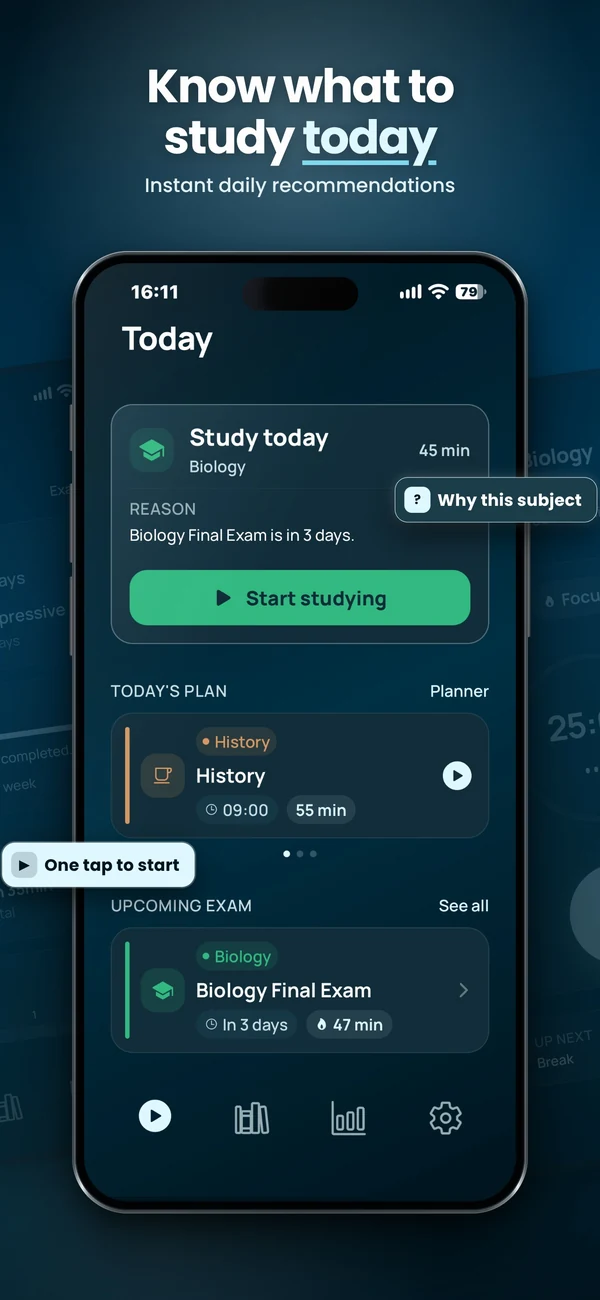
Estimate the hours and place study blocks, then use your evidence log to revise the plan. Vitae can track exam dates, hour targets, sessions and progress against those targets. It does not grade practice answers or measure mastery, so keep test results in your own notes or course system.
Keep the next session clear
Vitae helps turn exam dates and available hours into a study plan and a recommendation for today. Use your practice results to choose and revise the actual study task. Core planning is free; Premium is an optional one-time unlock.
Explore Vitae